
What a Shelton Resident Lookup Can Confirm
A useful resident lookup separates the person being researched from the role shown in each record. Shelton MapXpress can supply a parcel, owner-name, house-number, street, or map-lot lead. A recorded deed names parties to an instrument, while a directory may identify a subscriber or occupant from an earlier year. Court indexes show a party and case context, not a complete identity or outcome. Vital certificates establish a particular event, and voter or license systems have their own release rules. The table below keeps those limits visible before a name match is treated as proof.
| Record | What It Confirms | Where | Access |
|---|---|---|---|
| Assessed parcel | Owner-name, situs, map-lot, and current assessment lead | Shelton MapXpress | Public search; January 2026 parcel notice and nightly ownership/sales update |
| Deed, mortgage, or lien | Grantor, grantee, instrument type, date, legal description, and book/page or document placement | Shelton SearchIQS and City/Town Clerk | Index from January 3, 1944; images from August 24, 1978; counter fallback for older material |
| Directory or newspaper | Historical subscriber, occupant clue, obituary, event, or address mention | Shelton Library System | Regional runs and microfilm; collection and scan availability varies |
| Civil or family docket | Party name, docket, category, court location, and filing leads | Connecticut Judicial Branch | Public inquiry with a disclaimer; confirm material facts with the clerk |
| Probate case | Indexed name, case number, type code, district, and estate or guardianship lead | Connecticut Probate lookup | PD-42 data from January 5, 2011 to present; older district records need more research |
| Vital certificate | Event date, place, and eligible parent or spouse fields | Shelton clerk or Connecticut DPH | Birth, death, and marriage rules differ; copies require the proper requester |
| Voter registration | Registration and election-administration context, with year of birth under current release guidance | SOTS and Shelton registrars | Public UI capture gap; voter-file requests and use limits apply |
| Credential or business role | License type, number, status, entity, principal, agent, or address role | Connecticut eLicense | Public lookup and roster; an address role is not residence proof |
| Custody or registry record | Status within the narrow DOC or registry system searched | State custody and registry systems | No Shelton or Fairfield County jail roster was located |
| Unclaimed property | Name, city, or state claim lead | Connecticut Big List | Free search and claim filing; the Treasurer verifies ownership |
Begin with the least intrusive source that fits the question. A parcel lead helps when the concern is an address. A probate or vital record fits a family or estate question. A court search needs a docket, location, and disposition check. None of these systems is a universal resident file, and a same-name result can belong to a different person.
Note: A recorded party or assessed owner can differ from the person who occupied the Shelton address on the source date.
A Shelton Name Needs Two Anchors
Name-only searching creates false matches quickly. Keep the indexed spelling, then add one stable detail such as a street, map-lot, middle initial, spouse or parent, approximate year, court district, license number, or recording instrument. Compare the source date with the date of the question. A 1931 directory entry and a 2026 assessment record can describe different people, or the same person at different points in life.
Shelton also has a local label problem worth planning for. The official Connecticut town history records Shelton as formerly Huntington, incorporated from Stratford in January 1789, and renamed from Huntington by the General Assembly on April 15, 1919. An older deed, directory, church record, or probate reference may use Huntington or Stratford rather than Shelton. Search the names together before deciding that a historical resident record is missing. Preserve variants, married names, initials, abbreviations, and OCR errors instead of silently correcting them.
Name lead → parcel or address clue → record role → date and place check → custodian confirmation.
Court Geography in a Shelton Resident Lookup
Shelton is in the Ansonia-Milford Judicial District. Civil and family matters are handled in Milford, while Shelton Part B criminal and motor-vehicle matters route to GA5 Derby. The district serves Ansonia, Beacon Falls, Derby, Milford, Orange, Oxford, Seymour, Shelton, and West Haven. A Shelton address therefore does not point to a separate “Shelton court.” Juvenile matters are not available in the public online search.
The criminal public-information page describes searches by defendant last name, docket number, or all docket and schedule options for most pending criminal and motor-vehicle cases. If a matter is absent online, it may not be disclosable through the clerk. A pending row is only a lead, not proof of guilt or a final outcome. Match the court location and docket before attaching a result to a person.
The Ansonia-Milford criminal-case lookup information shows why court routing belongs in the first search notes.
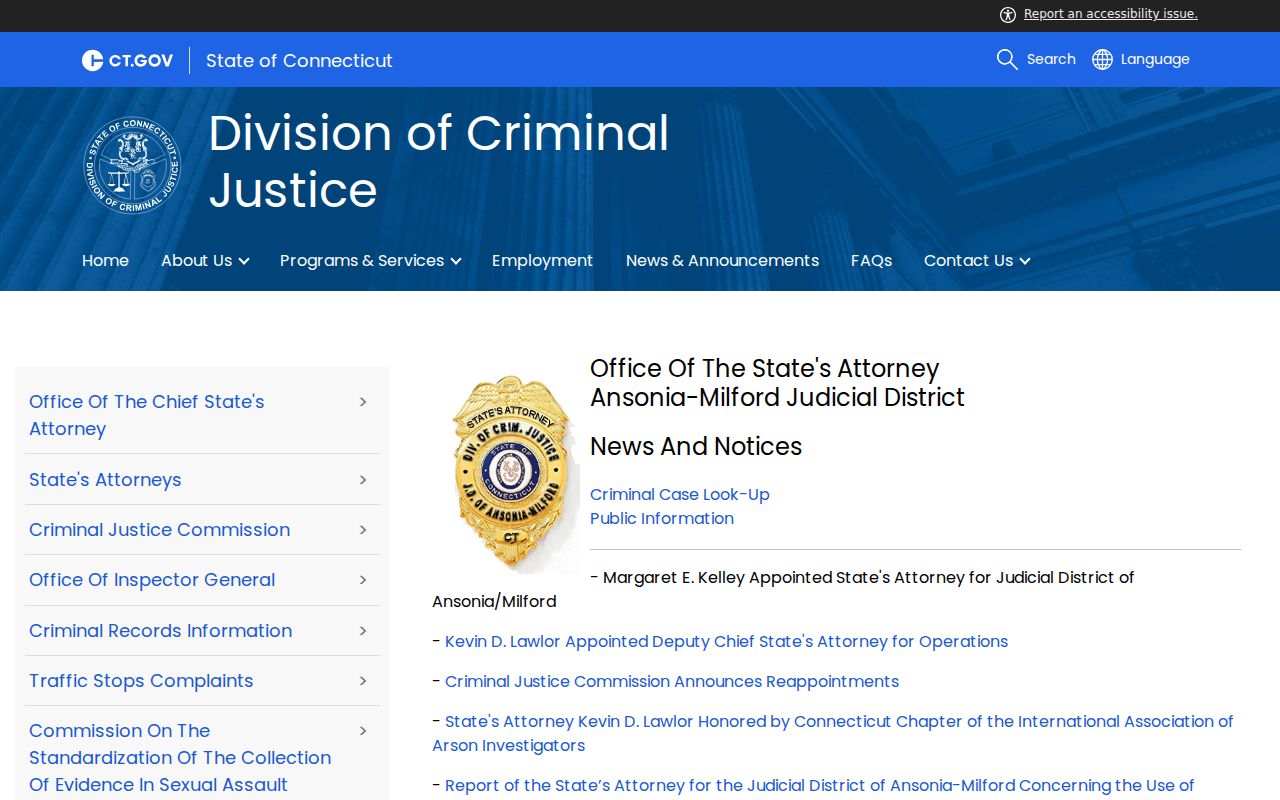
Use the district and case type as identity anchors. They narrow the search without turning a public court lead into a broader personal profile.
Shelton Civil Party Fields
The Connecticut Judicial Branch party search starts with a required last name and lets the researcher narrow by first name, location, category, type, sort order, and name-search method. The available name modes are Starts With, Contains, Is Equal To, and Sounds Like. Select Milford or another known location when the venue is clear, but keep the search statewide when the location is uncertain.
| Field | Type | Required | Use or option |
|---|---|---|---|
| Party Last Name | Text | Yes | Indexed surname and the required starting point |
| Party First Name | Text | Optional | Narrows a common surname |
| Location | Dropdown | Optional | Choose the court location or district when known |
| Case Category | Dropdown | Optional | Portal-supplied category choices |
| Case Type | Dropdown | Optional | Narrows the selected category |
| Sort Order | Dropdown | Optional | Portal-supplied result sorting |
| Name Search Type | Radio | Optional | Starts With, Contains, Is Equal To, or Sounds Like |
| Search or Reset | Controls | Action | Run the search or clear the fields |
The broader civil inquiry also offers docket-number, attorney or firm, property-address, short-calendar, court-event, legal-notice, and pending-foreclosure modes. A party result can reveal a name, docket number, category, type, and court location. The online display is not the official court file, and protected, sealed, or unavailable material is omitted. When the online view is thin, use the appropriate public-access terminal or clerk counter in Milford, Derby, or Shelton Probate, and request the underlying file from that custodian.
The Connecticut civil docket search shows the controls used after a party lead has been found.
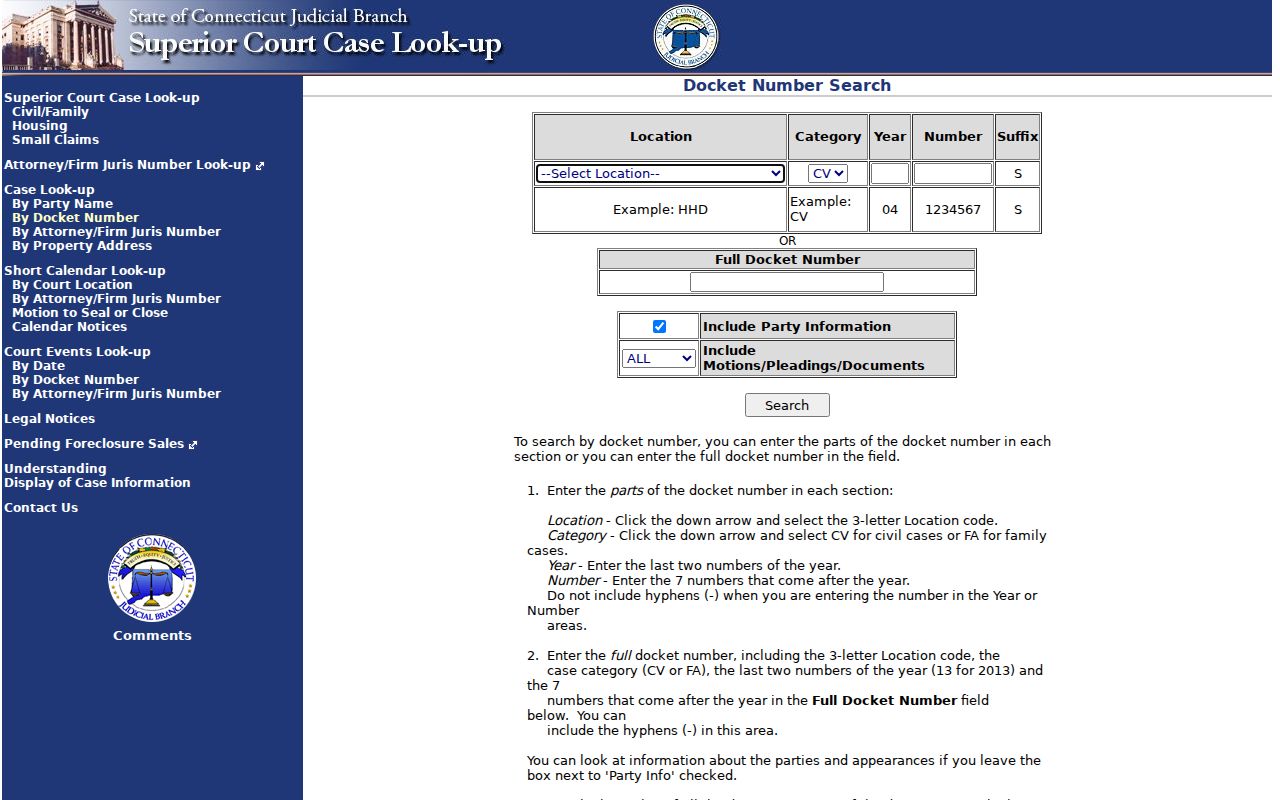
Read the docket, filing, appearance, and disposition information together. If the result matters, confirm the role and outcome with the Milford or Derby clerk.
Public docket result inventory
- Location and category, including CV Civil or FA Family.
- Docket components with a two-digit year, seven-digit number, and S suffix, or a full docket number.
- Party information when the inclusion control is selected.
- Motions, pleadings, and documents set to all, none, or the last ten.
- Appearances, status, disposition, images, and redactions only as the public row exposes them, with clerk verification when the captured result is incomplete.
Probate PD-42 for a Shelton Resident Lookup
Shelton Probate District PD-42 is a local path for an estate, guardianship, conservatorship, or related name search. The court is at 40 White Street, Shelton, and the researched locator lists Judge Fred J. Anthony, Chief Clerk Anne Marie Marcinczyk, and weekday hours from 9:00 a.m. to 5:00 p.m. The online case lookup says its data runs from January 5, 2011 to the present.
Search by district, last name, and first name, then compare the case status choice of Both, Open, or Closed. The result legend shows a case number, indexed name, type code, and district. Codes such as DR, DS, DAT, and DT appear in the portal, but the legend should be used before assigning a meaning to a code. A name row does not expose a complete probate file or establish an estate outcome.
The Connecticut Probate case lookup is the right starting point for a current PD-42 index search.
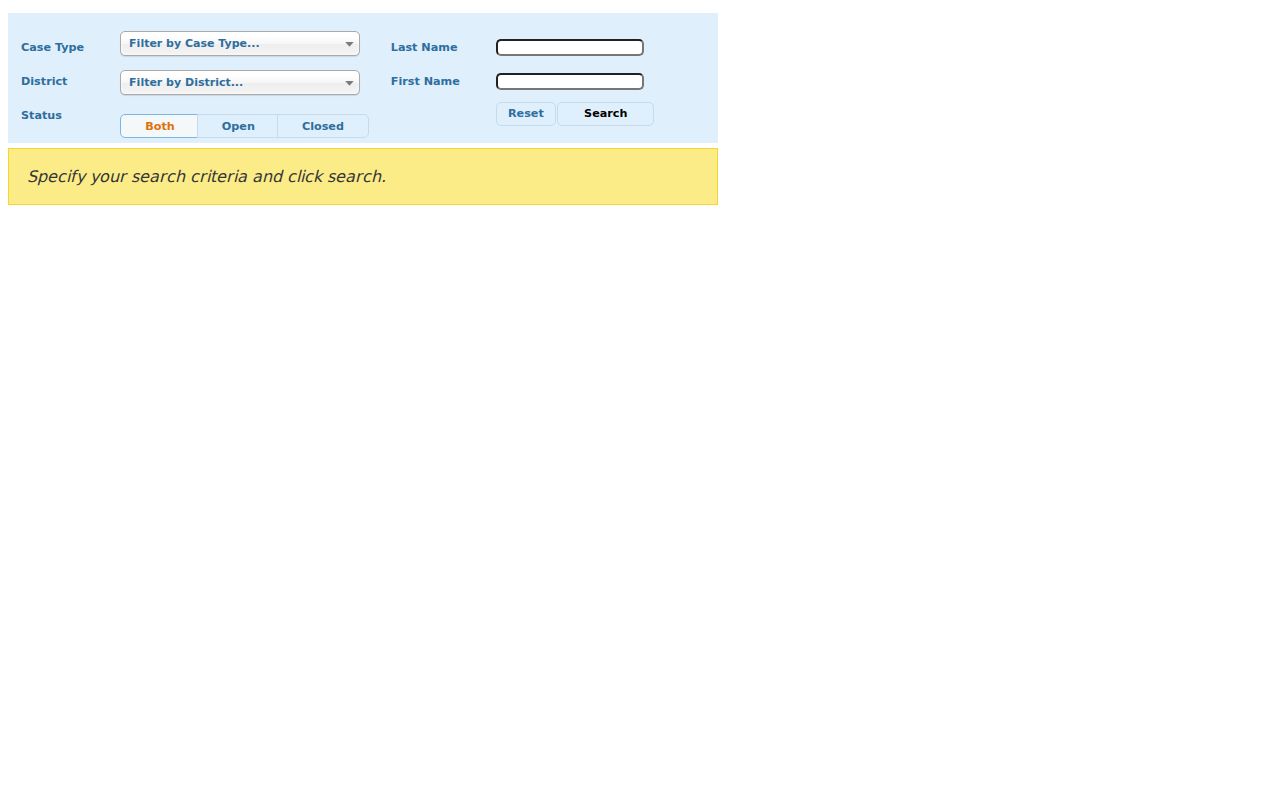
The image points to the name-search route, while the underlying file may require a request to the clerk. Shelton’s probate district was constituted in May 1889 from portions of Bridgeport and Derby, so older people can appear under predecessor districts or State Library holdings.
Probate result inventory
- Case number and indexed name as returned by the system.
- Type code, with the portal legend used for interpretation.
- PD-42 district and the search context for open, closed, or both cases.
- Result navigation toward case detail when available, without assuming that the full file or image is online.
- Any protected or sealed material must be checked with the Probate Court rather than inferred from an empty result.
Shelton Vital Records and Resident Identity
Connecticut DPH maintains statewide births, marriages, deaths, and fetal deaths from July 1, 1897 to the present, while town offices keep local records. For a Shelton event, the City/Town Clerk is the local counter and DPH is the statewide route. An event before July 1, 1897 calls for the town of event, State Library material, FamilySearch, church records, or newspapers rather than a modern statewide certificate search.
Birth records under 100 years are confidential under CGS §7-51 and require an eligible requester with the required identity or relationship proof. A person 18 or older may purchase a death or marriage certificate under the captured rules, although Social Security information is limited. DPH lists mail, in-person, approved online or telephone ordering, and certified requests as access channels. Town copies are generally $20, a town birth form lists a $15 wallet option, state birth copies are $30, and state death or marriage copies are $20. A state request can take up to 12 weeks.
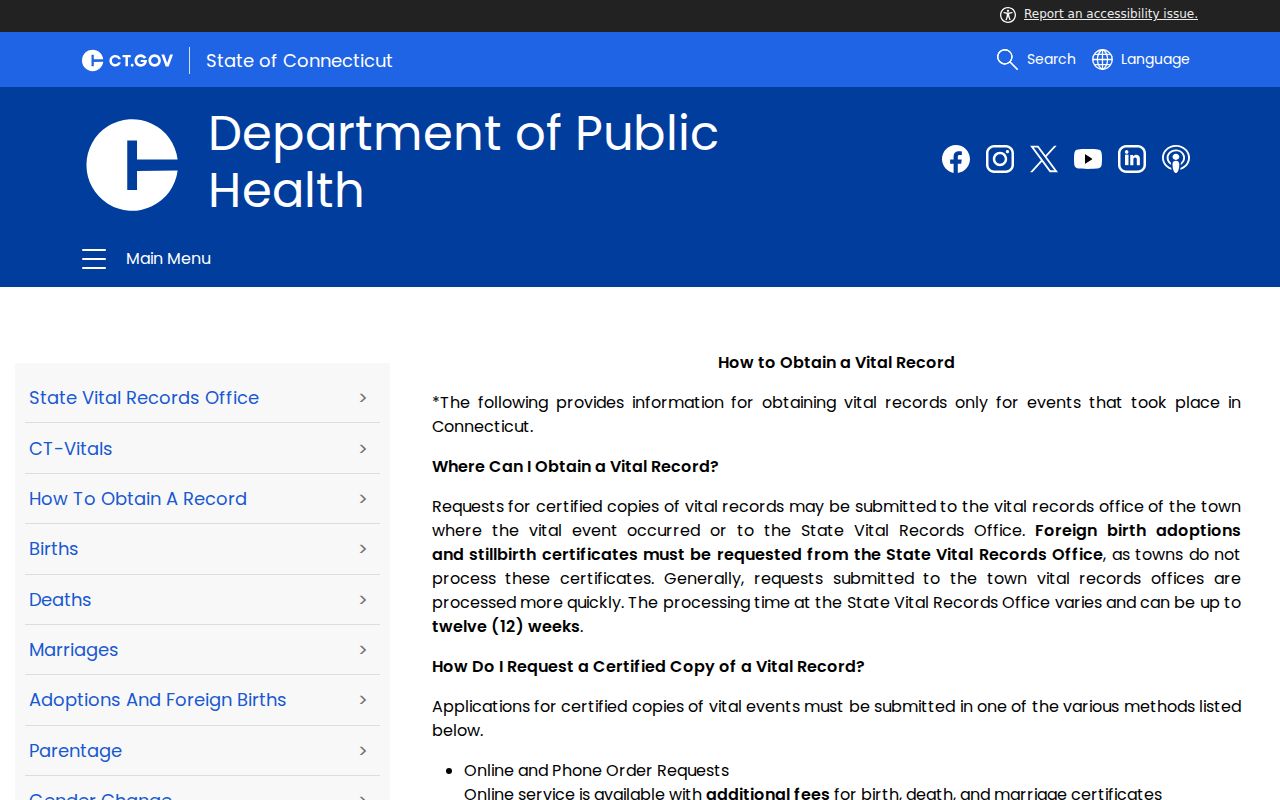
The Connecticut vital-record custodian guide sets out the town and state split that a Shelton resident lookup must respect.
A certificate can establish an event, date, place, parent, or spouse field. It does not become a current address record just because a familiar name appears on it.
The Connecticut vital-record request instructions show the identity, eligibility, and delivery steps behind a certified copy.
Keep the certificate type, event date, issuing office, issue date, requester eligibility, and redactions with the research note. DPH does not keep divorce decrees; the Superior Court that granted a divorce is the custodian.
Note: A restricted birth record cannot be opened by recasting the same request as a general public-records search.
Shelton Voter Records and Resident Identity
The Shelton Registrar of Voters processes applications, annual canvass work, elections, primaries, referenda, and related records at the Richard O. Belden Cultural Center, 54 Grove Street, second floor. The city lists Tuesday and Wednesday public hours from 8:00 a.m. to 3:00 p.m., and registration is available online, by mail, in person, and on Election Day except for primaries. Shelton has four election districts, with locations listed as Elizabeth Shelton School, Shelton Intermediate School, Long Hill School, and Mohegan School.
The state lookup is intended for a town and name workflow, but its live public form was not captured in the research run. Internal ConnVRE material mentions street and identifier searches, yet those controls must not be presented as a public full resident roster. SOTS says the centralized file includes registration applications and participation history, while current guidance limits released birth information to the year. A complete statewide file costs $300 and carries election-related, scholarly, journalistic, political, or governmental use rules. It is not a casual private name list.
Use voter information as one administration record among several. Compare the town, source date, status context, and privacy process, and never infer a full date of birth or ballot choice from a public record.
Credential and Unclaimed Names in Shelton
Connecticut eLicense searches more than 850 credential types through fields for type, prefix, number, status, business name, first name, last name, address, city, state, and ZIP. Its no-fee roster tool can return regulated credential lists. A result can show a license number, type, status, or address role, but a practice, business, or contact address is not proof that the person lives there. Save the credential type, status, issue or expiration detail, and portal date.
For a name that may connect to an unclaimed-property record, the CT Big List is the official free search and claim channel. The Treasurer's material warns that searching and filing a claim cost nothing and that fee solicitations should be treated with care. A name and city match is only a claim lead. The Treasurer verifies ownership, so do not treat the search result as a current address or entitlement.
Use the record's role. A licensee, claimant, directory subscriber, assessed owner, court party, and occupant clue are separate labels. Keeping them separate is the quickest way to avoid a false Shelton resident match.
Verify a Shelton Resident Record by Record
A defensible verification task has a narrow question and a stopping point. The goal may be to reconnect a family line, identify an heir, confirm that a court row belongs to the right person, or check a historical address. The source sequence should follow that purpose, not gather every available name field.
- Write the question and the record date. Decide whether the needed answer is an address clue, family event, court identity, estate lead, credential status, or historical mention.
- Anchor the name with a Shelton parcel, street, map-lot, town, age range, spouse, parent, or other stable detail. Treat MapXpress ownership data as an assessed-owner lead, not an occupant statement.
- Run the matching court or probate search with name variants. Save the court location, docket or case number, category, type, result status, and filing or disposition date.
- Use the appropriate vital, directory, newspaper, voter, license, or unclaimed-property source to test the identity. Request a certified copy from the custodian when an index line is not enough.
- Record the source URL, source date, record date, role, and unresolved gap. Stop when the question is answered, and ask the custodian when the record is material or the identity remains uncertain.
- Docket
- The court's identifying record number and case trail. It helps locate filings and parties, but a docket entry alone does not state guilt or prove residence.
- Index versus image
- An index is a finding aid with summary fields. An image or complete file is the underlying record when the custodian permits access, and it may be redacted or unavailable online.
- Certified copy
- A copy issued by the responsible office as an official copy. A screenshot or search result is not the same thing.
When the question shifts to everyone along a street, use the Shelton street directory for the address chain. Historical volumes and regional directory years belong with the Shelton directory book, where a subscriber clue can be read beside its year and section.
Privacy Limits on a Shelton Resident Lookup
Connecticut's Freedom of Information Act opens public records subject to exemptions, but it does not create a right to a private dossier. Birth records under the 100-year rule, Social Security information, DMV personal information, sealed or protected court material, protected victim information, and safety-program addresses may be unavailable. A narrow request to the correct custodian is more useful than asking an office to build a new list that its system does not maintain.
Connecticut's Address Confidentiality Program, Safe at Home, supplies an approved substitute mailing address and uses SOTS as legal agent for qualifying safety risks. Voter privacy is separate: a person may swear that disclosure would endanger the person or family, but that process does not create a confidential mailing address or shield every other record type. Never reproduce an actual protected address. DMV data also has its own federal and state limits and is not an unrestricted resident source.
For a separately held commercial listing, use the provider's own privacy or opt-out process, save the confirmation, and repeat when public-record refreshes repopulate a listing. Connecticut's data-privacy rules do not create a blanket deletion path for a valid municipal deed, court docket, or voter record.
Correct a wrong match through the office that holds the record. Keep a source copy, note the date, and remove unrelated sensitive facts from working notes.
Lawful personal use. Shelton records can support family history, estate research, civic questions, and careful identity verification. Do not use a resident lookup to stalk, harass, intimidate, threaten, or publish protected information about anyone.