
Shelton City Directories by Collection
Shelton city directories are best treated as a shelf of regional and companion sources, not as one complete run. The clearest catalog results join Ansonia, Derby, Shelton, and Seymour in a single title. That geography matters when a surname search seems to miss Shelton: the town may be inside a regional alphabetical or numerical section. The years below separate titles exposed in the catalog from broader discovery reports that still need a volume-by-volume check.
| Collection | Years | Where Held | Access |
|---|---|---|---|
| Regional Ansonia, Derby, Shelton, Seymour titles | 1931, 1968, 1973-74, 1975-76 | FamilySearch library-books catalog; local shelf status not established | Search the catalog, then confirm scan or affiliate access |
| Ansonia, Derby, Shelton telephone directory | 1901 | FamilySearch viewer and catalog | Viewer exposed an image control; readable entry needs verification |
| Reported regional discovery run | 1883 through 1960, with gaps | FamilySearch, library, Library of Congress, and archives | Discovery list only; verify each selected year |
| Shelton Herald archive | 1981-2006 | Plumb Memorial Library | PDF/archive run listed by the library |
| Evening Sentinel companion file | 1896-1992; bound 1950-1965 | Seymour microfilm and Plumb Memorial | Search by issue, date, and page for household events |
The broader discovery list includes 1890s volumes, 1901 and 1903, runs from 1906-1909 and 1912-1916, and later groups from 1948-1956 and 1959-1960. It is useful for planning, but it is not proof that every year is on a local shelf. Price & Lee appears in period directory context, yet the specific imprint should be checked in the scan or catalog record before it is assigned to a particular Shelton volume.
Regional City Directories for Shelton
The 1931 title is unusually helpful because its catalog name spells out five parts: governmental, buyers, alphabetical, numerical, and classified. The 1968 title likewise identifies a combined Ansonia, Derby, Shelton directory. These are not small details. A person can appear in the alphabetical section, while a street clue may work better in the numerical section. A classified business listing is a different kind of evidence and should not be treated as a household entry.
The FamilySearch Shelton-area directory search is the strongest starting point for locating these regional titles. Search Shelton and Huntington as place terms, then add Derby, Ansonia, Seymour, a surname, or a year. Availability varies by item. Some records expose a scan, while others show only catalog information or require an affiliate location.
The FamilySearch catalog view shows why a regional search is needed for Shelton volumes.
The result view is a catalog lead, not a promise that a readable Shelton entry is online. Record the title, year, place terms, and item link before moving to a library shelf or archive for the page itself.
Shelton Library Counter for Directories
Plumb Memorial Library at 65 Wooster Street is the main local research counter for Shelton historical directories, bound newspapers, microfilm questions, and catalog help. Huntington Branch Library at 41 Church Street adds a second local location, especially when the older record uses Huntington as a place name. The library system points readers to its own catalog, the Plumb and Branch catalog, Bibliomation, and FindIT CT. Ask staff whether a chosen volume is on site, in a consortium location, on microfilm, or available through a licensed database.
Public computers, Wi-Fi, and copying are available. The services page lists copies at $0.10 for black-and-white and $0.50 for color. Those details help when an old directory page or newspaper notice needs to be retained with its year and page number. The library does not claim a single public obituary index, so staff help and date-based newspaper searching remain important for family history.
The Shelton Library System services page shows the local setting for directory and newspaper research.
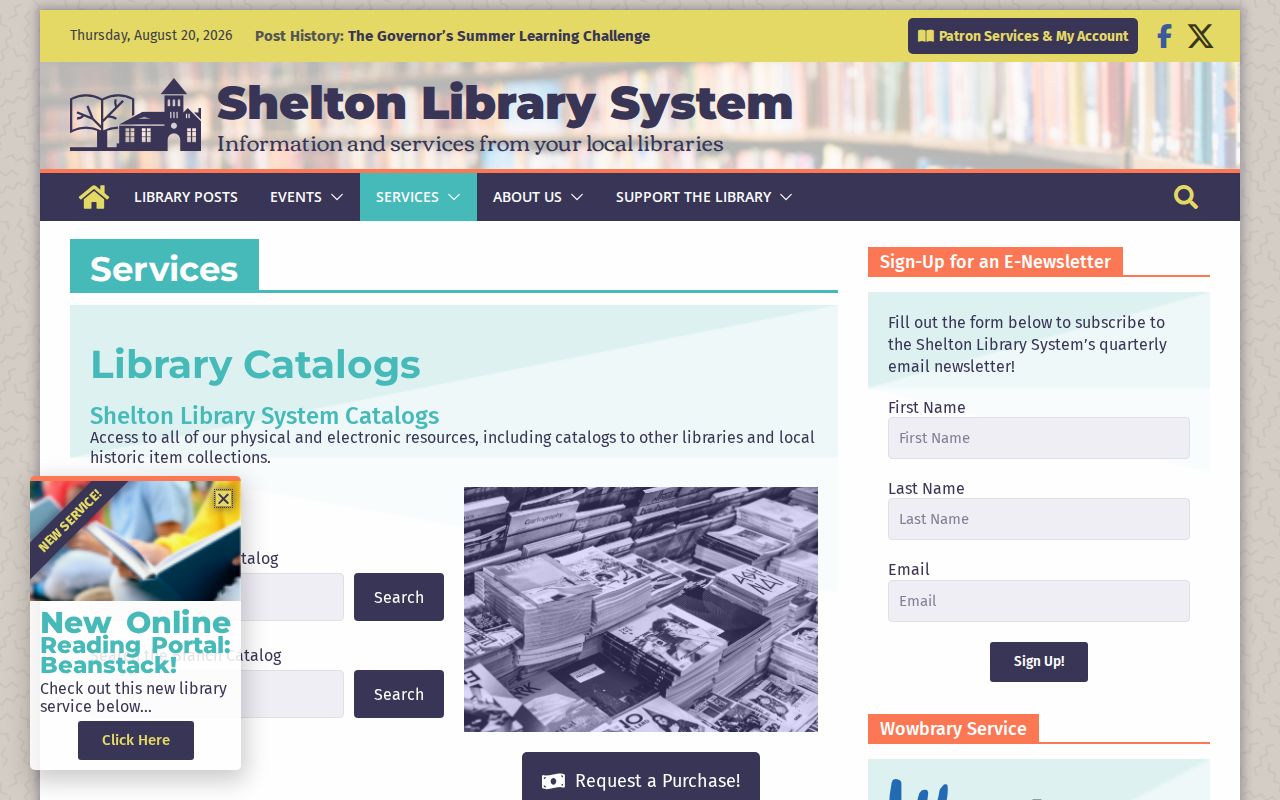
Bring a name, street, likely town label, and date range to the counter. A staff suggestion about a regional title can save a search that would fail under Shelton alone.
FamilySearch Fields for Shelton Directories
FamilySearch has two useful paths: the library catalog for books and the Connecticut historical collection for indexed events. The catalog can be narrowed by place, title, author, subject, surname, or call number/DGS. Place is the key field for Shelton because Huntington, Fairfield County, Derby, Ansonia, and Connecticut can lead to different catalog groupings.
| Place | Search Shelton, Huntington, Fairfield County, Derby, Ansonia, or Connecticut. |
|---|---|
| Keywords | Add a street, church, surname, or record term. |
| Titles and author | Use an exact or partial title, or a known directory publisher. |
| Subjects and surnames | Try directory, church, cemetery, vital, local-history, or surname terms. |
| Call Number / DGS | Use a cataloged microfilm or digital group identifier when one is known. |
| Availability | Filter for any, online, or library and affiliate choices shown by the catalog. |
| Historical collection | Name or alternate name, life event, location, keyword, family member, and birth-year range are captured field concepts. |
Image access, pagination, export, and account rules vary by item. A catalog result can locate a book without proving that its page images are open from home.
Note: Save the catalog title and year before changing place terms, because a regional result can disappear when the search is narrowed too soon.
Reading a Shelton City Directory Entry
A Shelton directory entry is a compact historical clue. It may connect a name to a street, a telephone subscriber line, an occupation, or a household notation, but the exact fields depend on the volume. The inspected 1901 FamilySearch viewer did not expose a readable page, so the scan, not a generic directory convention, must control the transcription.
Use the alphabetical and numerical sections together. Copy initials, spelling, punctuation, street numbers, and any small marks exactly. If a spouse, widow notation, occupation, owner mark, or residence symbol appears, preserve it as printed and cite the page. Do not turn a directory subscriber into every member of a household.
| Name | Surname and given name or initials, with historical spelling preserved. |
|---|---|
| Address | Street and number as printed in an alphabetical or numerical listing. |
| Occupation | A historical field that may appear, if the selected volume prints it. |
| Spouse or family notation | Record parentheses, widow wording, or other relationship text only when visible. |
| Owner or residence mark | Check the volume legend; never import a symbol from another publisher. |
- Criss-cross directory
- An address-order route through a directory. Shelton's 1931 title confirms a numerical section, which is the closest captured local lead; the full page layout needs scan verification.
- Householder index
- A name-centered listing tied to a head or subscriber. It is a finding aid, not proof that every person connected with the address is listed.
- Abbreviation key
- The publisher's own legend for short terms and marks. Photograph or transcribe it before reading entries across several pages.
1931 Shelton Directory Sections
The 1931 Ansonia, Derby, Shelton, Seymour title offers a useful map of how a regional city directory was organized. Governmental and buyers sections provide institutional or commercial context. Alphabetical entries support a name search. Numerical entries offer the most direct address route. Classified pages describe categories of goods or services, so they need a different reading rule from a resident or subscriber listing.
- Start with the town and year printed on the title page.
- Use the alphabetical section for a surname and variant initials.
- Use the numerical section for an old street and number.
- Read classified and governmental pages as context, not a full resident roll.
- Keep the page number and section name with every transcription.
Shelton's record geography adds another check. The town was formerly Huntington, incorporated from Stratford in January 1789, and renamed by the General Assembly on April 15, 1919. A pre-1919 directory or related record may use Huntington, while an older trail may point to Stratford. Search both names before deciding that a household is absent.
Maps help reconcile the words on a page. Library of Congress Sanborn sheets from 1896, 1901, 1906, and 1912 are filed under Derby while noting Shelton as an original-place reference. The 1898 Derby, Shelton, and East Derby map adds business and landmark context. A canal, railroad, trolley, school, church, or river reference can identify the right part of town when a modern street label no longer fits.
The catalog evidence supports a cautious directory timeline:
- 1901: An early Ansonia, Derby, Shelton telephone directory appears in the FamilySearch catalog with an image viewer.
- 1931: A regional title names governmental, buyers, alphabetical, numerical, and classified sections.
- 1968: A combined Ansonia, Derby, Shelton, Seymour title appears in the catalog search.
- 1973-74 and 1975-76: Later regional titles appear, but neither is established as the final printed year.
Note: A regional volume title and a Shelton place name answer different questions, so preserve both when you cite an old household clue.
Shelton Directory Archives and Clerk
The Shelton Historical Society at 70 Ripton Road offers research by appointment and can be asked about photographs, maps, yearbooks, factory files, church material, family files, and cemetery sources. Its research collection is not a public resident roster. The Connecticut State Library is the archive fallback for town histories, judicial material, vital and genealogical collections, microfilm, and originals. FamilySearch also catalogs White Hills Baptist Church records from 1838-1932, with members listed for 1838-1919.
The Shelton City/Town Clerk is a separate records custodian. The office at 54 Hill Street holds land instruments, maps, local vital certificates, municipal minutes, election material, licenses, registrations, and other permanent records. That counter can establish a legal instrument or certified fact, but it is not a searchable directory. Pair its record with a directory, map, or newspaper rather than treating a deed or certificate as proof of everyone living at an address.
The Shelton Historical Society research information shows why an appointment can complement the printed shelf.

Ask for a source by year and record type. A historical photograph or church register can add family context, while the clerk's land record or a State Library item supplies a more formal record trail.
Note: No standalone Shelton-wide obituary index was located; newspaper runs, funeral notices, library staff, and archive appointments fill that search gap.
Tracing a Shelton Household by Year
For family history, start with the strongest known name or address, then move through nearby directory years rather than guessing a continuous run. The regional title may omit a person, change an initial, or use a different town label. Pair a directory clue with a deed, map, newspaper, cemetery transcription, church record, or vital source that covers the same period. Each source answers a narrower question.
- Find the first likely appearance in an alphabetical or numerical section and copy the exact name, address, and page.
- Check the volume's abbreviation key, then search the same name with initials and the Shelton or Huntington place term.
- Compare the next available directory year and note moves, gaps, changed street wording, or a different household notation.
- Pair the directory year with the closest available census schedule or local newspaper run, keeping the source dates separate.
- Use a deed, map, church or cemetery record, probate file, or vital record to test the family connection rather than assuming it.
If a name disappears, several explanations remain possible: a move, death, an unlisted subscriber, a regional volume gap, or an index spelling change. An obituary may give a last-known residence, while a cemetery record may give family and place context. A deed identifies parties to an instrument. None of these alone proves that every household member lived at the address.
The resulting timeline should hold the directory year, section, printed wording, page, and archive or catalog location. That practice makes a Shelton volume useful for reconnecting relatives and understanding a household without overstating what the page can show.